
Bioenergetic Healing – A Closer Look
1️⃣ What Is Bioenergetic Healing?
Bioenergetic healing is based on the understanding that the human body is not only biochemical (hormones, nutrients, enzymes), but also electrical, electromagnetic, and energetic.
Long before modern instruments could measure electrical signals and electromagnetic fields, many traditional healing systems described health in terms of energy flow and balance.
- In Traditional Chinese Medicine (TCM), this vital energy is called Qi, flowing through networks known as meridians.
- In Ayurvedic medicine, the vital life force is called Prana, moving through channels known as nadis and influencing physical, mental, and emotional health.
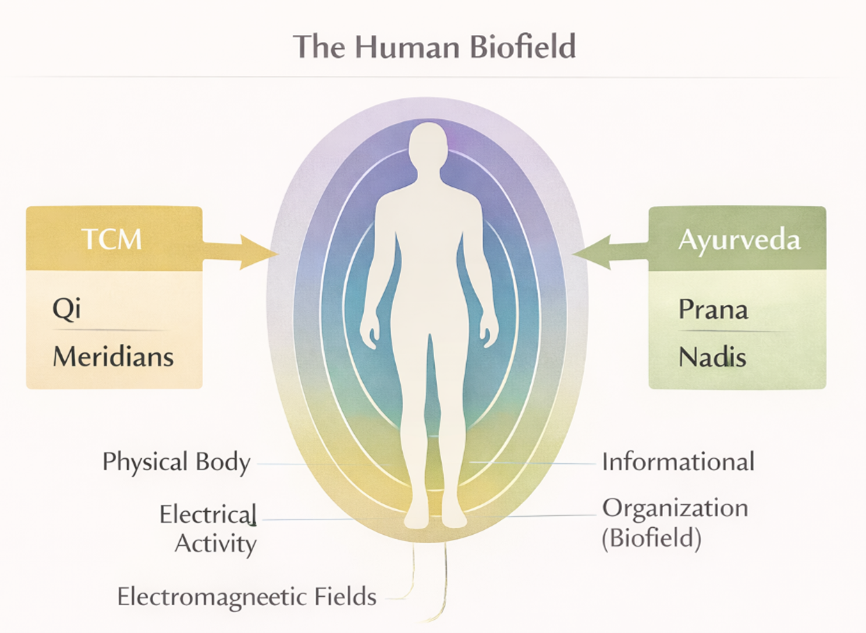
These systems, which are still widely practiced today around the world, focus on restoring balance and supporting the body’s natural regulatory capacity rather than targeting isolated symptoms. Bioenergetic healing can be seen as a modern extension of this same whole-systems perspective, informed by both traditional models and contemporary science.
From a physiological perspective, every cell communicates using:
- Electrical signals (nerve impulses, membrane potentials)
- Electromagnetic activity generated by organs such as the heart and brain (measurable by ECG and EEG)
- Complex signaling patterns that coordinate regulation, adaptation, and healing
The body continuously generates measurable electrical and magnetic fields. The heart produces strong rhythmic electromagnetic activity, and the brain generates electrical rhythms (“brainwaves”) that reflect functional states such as sleep, relaxation, focus, and alertness.
Research also shows that the brain can synchronize to rhythmic input — a phenomenon known as brainwave entrainment — illustrating that biological systems respond to frequency-based signals in measurable ways.
Modern medicine already uses energy and frequency in many ways:
- ECG and EEG measure electrical activity.
- MRI uses magnetic fields and radio frequencies.
- Ultrasound uses sound waves.
- PEMF and microcurrent therapies use electrical stimulation.
These technologies demonstrate that biology is deeply influenced by energetic and electrical processes — not only chemistry.
Bioenergetic healing modalities explore how subtle energetic patterns and field interactions may reflect functional stress and regulatory imbalance earlier than physical symptoms appear.
Rather than diagnosing disease, bioenergetic tools aim to identify patterns of stress, imbalance, or overload in the body’s regulatory systems, supporting personalized strategies for restoring balance and resilience.
2️⃣ The Human Energy Field & the Biofield [1][2][3]
In integrative health research, the term biofield refers to a proposed organizing field of energy and information associated with living systems. It provides a framework for exploring how biological systems maintain coherence, communication, and regulation across multiple levels.
The biofield concept integrates several layers:
- Measurable electrical and electromagnetic activity generated by organs and cells, such as heart rhythms and brainwaves
- Information signaling and timing patterns that coordinate biological rhythms, regulation, and adaptation
- Emerging hypotheses that additional subtle organizing fields may exist beyond current measurement tools
From a biophysical perspective, research has shown that the human body continuously generates electrical and electromagnetic fields that are real, measurable, and essential to physiological function. These fields interact internally and with the surrounding environment and play a role in communication and regulation within the body.
In addition, research in biophysics has shown that living cells emit ultra-weak light, known as biophotons. These emissions are measurable and reflect cellular metabolic and regulatory processes. Within biofield research, biophotons are explored as one possible component of how biological systems communicate and maintain coherence, alongside electrical and electromagnetic signaling. While this research is ongoing, it provides an example of how light-based processes may contribute to the body’s energetic organization.
Taken together, this perspective suggests that the human energy field is not something separate from biology, but rather reflects layered electrical, electromagnetic, and informational organization that science continues to investigate.
3️⃣ Brief History of Bioenergetic Testing
Modern bioenergetic testing developed primarily in Europe, combining early electrophysiology with acupuncture theory and emerging concepts of biological signaling.
Electro-Acupuncture According to Voll (1950s) [4][5][6]
German physician Dr. Reinhold Voll pioneered Electro-Acupuncture According to Voll (EAV) in the 1950s. He observed that acupuncture points showed different electrical properties than surrounding skin and that changes in electrical resistance sometimes correlated with functional patterns in the body.
EAV uses electrical measurement at specific meridian points and, in some systems, evaluates how readings change when substances are introduced into the measurement circuit — an early form of biofeedback about how the body responds.
This work formed the foundation for many later electrodermal and bioenergetic assessment systems. Historical and clinical reviews describe the technical principles of EAV while noting that its broader diagnostic claims remain an area of ongoing study.
Vega Testing & Electrodermal Screening (1970s)
In the 1970s, practitioners such as Helmut Schimmel adapted Voll’s work into simplified systems such as the Vega test, which focused on rapid functional and sensitivity testing rather than medical diagnosis.
Related approaches — often referred to as Electrodermal Screening (EDS) or Meridian Stress Assessment (MSA) — evolved from the same framework and continue to be used in some European complementary health practices.
These systems share a common lineage: measuring electrical properties at acupuncture points to explore functional stress patterns.
Bioresonance & Frequency-Based Systems (1970s–1990s) [7][8][9]
Another branch of bioenergetic technology emerged in Germany in the late 1970s with bioresonance systems, initially developed by Franz Morell and Erich Rasche (MORA therapy).
These systems proposed that biological systems express characteristic frequency patterns and that electrical or electromagnetic signals could be used to detect or influence these patterns. Over time, this concept led to computerized bioresonance devices used in holistic clinics across Europe.
Scientific reviews describe bioresonance as an alternative modality that continues to be studied, with ongoing discussion about mechanisms and clinical validation.
Modern Digital Systems (2000s–present) [10]
Today’s bioenergetic systems integrate:
- Digital frequency databases
- Software analytics
- Non-invasive measurement interfaces
They are designed as informational wellness tools rather than medical diagnostic devices, supporting holistic practitioners in identifying functional patterns and guiding personalized wellness strategies.
4️⃣ How Bioenergetic Healing Supports Your Wellness Journey
Bioenergetic testing and feedback can help:
- Identify early stress and imbalance patterns before symptoms escalate
- Reveal regulatory overload across systems
- Support individualized healing strategies
- Track changes over time as the body re-regulates
It works best when integrated with:
- Functional nutrition and lifestyle changes
- Nervous system regulation
- Mind-body awareness practices
Bioenergetic modality is part of the holistic, whole-system approach to sustainable health and resilience.
5️⃣ Informational Videos
Video: Energy Explained
References
- Rubik B. et al. (2015). Biofield Science and Healing: History, Terminology, and Concepts. Global Advances in Health and Medicine. Full article (PMC)
- Cifra M., Pospíšil P. (2014). Ultra-weak photon emission from biological samples. Journal of Photochemistry and Photobiology B: Biology. Journal article (Elsevier)
- Mould R.R. (2000). Ultra-weak photon emission — a brief review. Journal of Photochemistry and Photobiology B: Biology. Review on biophoton emission (PMC)
- Oleson, T. (2002). Electrodermal screening (EAV): A historical and scientific overview. Journal of Chinese Medicine. PubMed
- Oliveira, A. (2016). Electroacupuncture According to Voll: Historical background and literature review. Meridians: Journal of Acupuncture and Related Techniques. ResearchGate
- Schmidt, R. A., & Walter, G. (2008). Electrodermal measurements at acupuncture points: Methodology and relevance to EAV. Journal of Alternative and Complementary Medicine. PubMed Central
- Mureșan, D., Andreescu, N., & Dumitrașcu, D. L. (2014). Bioresonance therapy in clinical practice: A review of clinical studies. Journal of Complementary and Integrative Medicine. PubMed Central
- Galle, M. (2007). Review of MORA therapy and bioresonance principles. PDF
- History of Bioresonance – International Society for Bioregulatory Medicine (ISBM). History of Bioresonance.
- Bioresonance Medicine – International Society for Bioregulatory Medicine (ISBM). Bioresonance Medicine.